[conference] Spotlight at ICML 2026
Our work on improving the performance and training stability of parallelizable RNNs for ultra-low power applications got accepted as a Spotlight at ICML 2026!
I’m thrilled to share that our paper “Improving the Performance and Learning Stability of Parallelizable RNNs Designed for Ultra-Low Power Applications” has been accepted as a Spotlight at ICML 2026! This is a huge milestone for our team.
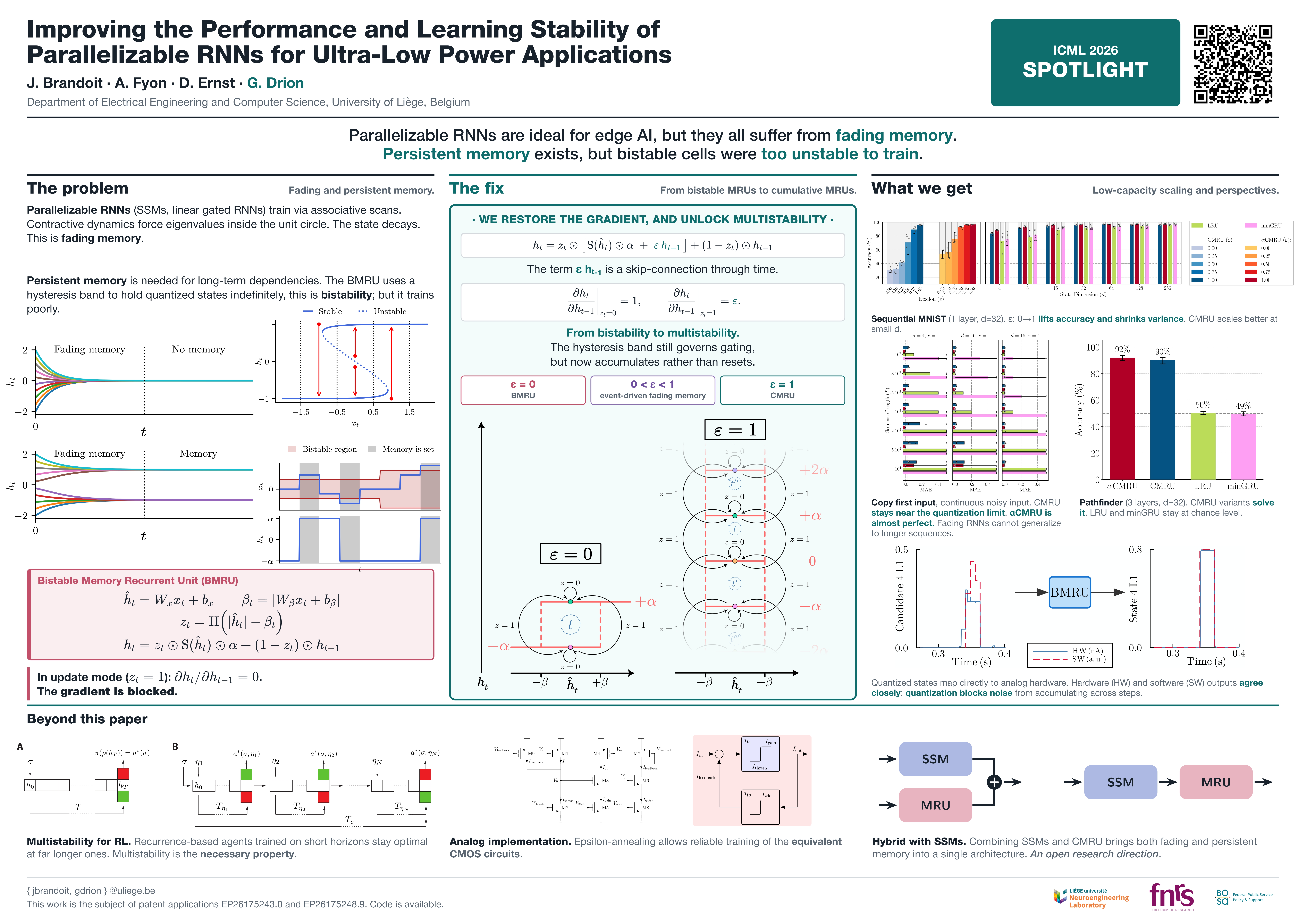
Parallelizable RNNs are a family of recurrent architectures that can be trained efficiently via parallel scan rather than sequential unrolling – a huge win for training speed. They are also great candidates for ultra-low power inference: their fixed recurrent structure maps naturally to analog hardware. But getting them to train well and perform well at the same time is non-trivial. That’s exactly what this paper tackles.
The problem
Standard parallelizable RNNs struggle with two intertwined issues when pushed toward real-world, hardware-friendly settings: performance gaps compared to more expressive (but sequential) models, and training instability that makes optimization unreliable. Both problems get worse as you try to constrain the architecture for low-power deployment.
What we did
We identified the root causes of these issues and introduced principled modifications to the architecture and training procedure that address them jointly. The result is a family of parallelizable RNNs that trains more stably and achieves better task performance – without sacrificing the hardware efficiency that motivated the design in the first place.
Why it matters
The gap between “works in a paper” and “works on a chip” is wide. Ultra-low power applications – always-on sensors, wearables, edge inference nodes – impose hard constraints on memory, precision, and compute. A model that trains stably and performs well under those constraints is directly deployable, not just a proof of concept.
Poster
Resources
📄 Paper: ORBI · OpenReview.
Get in touch: questions or collaborations? Drop me an email at jbrandoit@uliege.be.
Arthur Fyon’s webpage: Arthur Fyon
Damien Ernst’s webpage: Damien Ernst
Guillaume Drion’s webpage: Guillaume Drion
Acknowledgments
Can’t wait for ICML 2026 – see you there!
This work has been the subject of a patent application under number EP26175243.0. and EP26175248.9.